
Walnuts
Nature's Brain
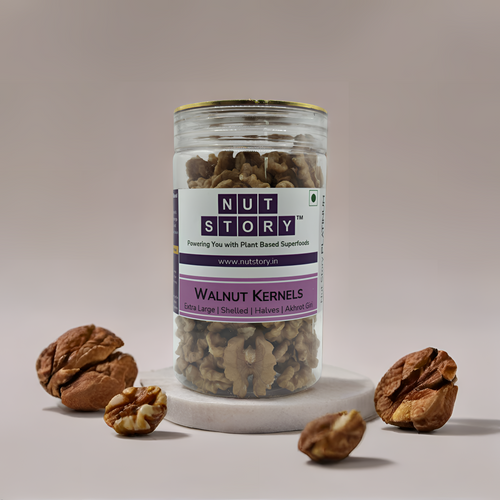
Did you know that walnuts look remarkably like the human brain?
Split open a walnut and you'll notice something fascinating.
Its two lobes resemble the left and right hemispheres of the human brain. Even the folds and ridges bear a striking resemblance to the brain's surface.
This similarity captured human imagination for centuries. Ancient cultures often believed that foods resembling parts of the body were connected to those organs—a concept sometimes called the Doctrine of Signatures.
Whether coincidence or clever design by nature, the walnut's appearance helped establish one of the most enduring food symbols in history.
Today, walnuts remain one of the world's most recognized "brain foods."
For thousands of years, walnuts have been associated with the human mind. Their brain-like appearance, combined with their remarkable longevity as a tree and their ability to travel across civilizations, gave them a unique cultural identity that no other nut can claim. The walnut's story is one of intelligence—both nature's design and humanity's recognition of it.
Some foods nourish the body.
A rare few capture the imagination.
Walnuts have done both for thousands of years.
Their striking resemblance to the human brain made them objects of fascination long before modern nutrition science. Ancient philosophers, physicians, and scholars saw the connection and drew conclusions that, remarkably, later science would revisit.
Beyond their appearance, walnuts earned a global reputation through centuries of trade. They travelled the Silk Road, nourished royal households in Persia, and became deeply embedded in food cultures across Asia, Europe, and the Americas.
Today, walnuts remain one of the world's most widely consumed and most studied nuts. Their combination of flavour, heritage, and nutritional interest ensures that their story continues to grow.
Discover Fascinating Facts About Walnuts
Did you know that walnuts look remarkably like the human brain?
Split open a walnut and you'll notice something fascinating.
Its two lobes resemble the left and right hemispheres of the human brain. Even the folds and ridges bear a striking resemblance to the brain's surface.
This similarity captured human imagination for centuries. Ancient cultures often believed that foods resembling parts of the body were connected to those organs—a concept sometimes called the Doctrine of Signatures.
Whether coincidence or clever design by nature, the walnut's appearance helped establish one of the most enduring food symbols in history.
Today, walnuts remain one of the world's most recognized "brain foods."
Did you know that walnuts are among the oldest foods eaten by humans?
Archaeologists have discovered evidence suggesting that humans were eating walnuts thousands of years before the rise of modern civilizations.
Wild walnut trees provided a reliable source of nourishment, and their hard shells helped protect the edible kernel inside for extended periods.
Why did this matter?
Because foods that could be stored and transported were invaluable in a world without refrigeration.
The walnut's story began long before agriculture—and it continues today.
Did you know that walnuts were once known as the "Royal Nut"?
Ancient Persia, located largely within present-day Iran, produced some of the world's finest walnuts.
Historical accounts suggest that walnut trees were so highly valued that they became associated with royalty and privilege. In some traditions, the finest walnuts were reserved for kings and noble families.
This reputation helped walnuts earn the nickname "The Royal Nut."
Even today, walnuts retain an aura of prestige that reflects centuries of admiration and cultural significance.
Did you know that walnuts travelled the Silk Road?
The Silk Road connected Asia, the Middle East, and Europe through a vast network of trade routes.
Alongside silk, spices, precious stones, and textiles travelled walnuts.
Their durable shell made them ideal for long journeys, allowing traders to transport them across continents with minimal spoilage.
As walnuts moved from one civilization to another, they carried with them recipes, agricultural knowledge, and culinary traditions.
The walnut's journey helped transform a regional food into a global one.
Did you know that walnut trees can live for centuries?
Many fruit trees remain productive for a few decades.
Walnut trees think on a different timescale.
A healthy walnut tree can continue producing nuts for generations, and some historic specimens have survived for well over a century.
Imagine planting a tree whose harvests could be enjoyed by your grandchildren and great-grandchildren.
This extraordinary longevity has made walnut orchards valuable family assets throughout history.
Like the wisdom they symbolize, walnut trees are built for the long term.
Did you know that walnuts naturally contain Omega-3 fatty acids?
Omega-3 fatty acids are most commonly associated with oily fish, yet walnuts are one of the best-known plant sources of Alpha-Linolenic Acid (ALA), a type of Omega-3.
This fact has contributed significantly to the walnut's modern reputation as a "brain food."
Interestingly, people associated walnuts with intelligence long before scientists understood Omega-3s.
Sometimes tradition notices something long before science explains it.
Did you know that a walnut shell is a masterpiece of natural engineering?
The shell of a walnut performs a difficult task.
It must be strong enough to protect the seed from insects, weather, and predators, yet eventually allow access to the nutritious kernel inside.
This protective design helped walnuts survive in the wild and allowed humans to transport them over long distances without sophisticated preservation methods.
The shell isn't merely packaging.
It's one of the reasons walnuts became successful across civilizations.
Did you know that not all walnuts are the same?
When people say "walnut," they are usually referring to the English Walnut, the variety most commonly eaten worldwide.
However, there are other walnut species, including Black Walnuts, which are known for their stronger flavour and harder shells.
English Walnuts are generally preferred for snacking and culinary use because they offer a milder taste and are easier to crack.
The walnut family is more diverse than most people realize, and each variety has developed its own personality over centuries.
Did you know that Chilean walnuts are prized for their light colour and mild flavour?
Chile has become one of the world's most respected walnut-producing regions.
Its Mediterranean climate, long growing season, and favourable harvest conditions help produce walnuts that are often lighter in colour and milder in flavour than many other varieties.
These characteristics make Chilean walnuts particularly popular for premium retail packs, baking, gifting, and direct snacking.
In the walnut world, origin matters.
Just as coffee, tea, and wine reflect the regions where they are grown, walnuts can also express the character of their environment.
Did you know that Kashmir is famous for some of India's finest walnuts?
When most people think about walnuts in India, they think about Kashmir.
The region's cool climate, fertile valleys, and long agricultural tradition create ideal conditions for walnut cultivation. Walnut trees have been part of Kashmiri landscapes for generations, contributing both to local livelihoods and culinary traditions.
Many consumers appreciate them for their distinctive flavour, natural growing conditions, and strong connection to one of India's most celebrated horticultural regions.
For many Indians, the walnut's story begins not in Persia or Europe, but in the valleys of Kashmir.
Did you know that walnut wood is almost as valuable as the nut itself?
Most food crops are grown for a single purpose.
Walnut trees are different.
In addition to producing premium nuts, walnut trees are renowned for their beautiful wood. Walnut timber has long been prized for furniture, decorative interiors, carving, and fine woodworking because of its strength, durability, and rich grain patterns.
This means a walnut tree can create value in more ways than one.
Few agricultural trees have contributed so much to both kitchens and craftsmanship.
Did you know that walnuts naturally contain antioxidants?
Trees cannot run away from environmental challenges.
Instead, they rely on sophisticated natural compounds to protect themselves from sunlight, weather, insects, and other stresses.
Walnuts contain naturally occurring antioxidants and plant compounds that help support the tree throughout its life cycle.
When we eat walnuts, we consume many of these same naturally occurring compounds.
Nature's survival tools often become part of our food as well.
Did you know that walnuts appear in cuisines across multiple continents?
Few nuts have travelled as successfully as walnuts.
From Persian dishes and Mediterranean baking to European pastries, Middle Eastern desserts, Chinese cuisine, and Indian recipes, walnuts have found a place in remarkably diverse food cultures.
Why?
Because walnuts bring something distinctive to a recipe: texture, richness, and character.
Their slightly earthy flavour makes them instantly recognizable, whether they appear in a festive dessert or a savoury dish.
Did you know that walnuts were once considered symbols of wisdom?
Long before modern nutrition science existed, walnuts fascinated philosophers, physicians, and scholars because of their resemblance to the human brain.
Over time, this visual connection helped establish walnuts as symbols of intelligence, learning, and wisdom.
Whether in folklore, traditional medicine systems, or cultural symbolism, walnuts frequently appeared as foods associated with the mind.
Few foods have inspired such a powerful and enduring metaphor.
Did you know that walnut orchards are often family legacies?
Because walnut trees can remain productive for decades, many orchards are built with future generations in mind.
A farmer planting walnut trees today may be creating harvest opportunities for children and grandchildren who have not yet been born.
This long-term perspective makes walnut cultivation different from many annual crops.
In a world increasingly focused on immediate results, walnut orchards encourage patience and stewardship.
Did you know that cracking a walnut was once considered a test of skill?
Before modern processing equipment, opening walnuts efficiently required experience and technique.
The challenge was not simply breaking the shell—it was preserving the kernel inside.
A clean, intact walnut kernel was often considered more valuable because it required greater care to extract.
This challenge explains why walnut crackers became common household tools and why whole kernels continue to be prized today.
Did you know that walnuts are naturally cholesterol-free?
Like all nuts and plant foods, walnuts contain no dietary cholesterol.
Instead, they are known for their healthy fat profile, including naturally occurring Omega-3 fatty acids and other unsaturated fats.
These fats contribute to the walnut's rich flavour and satisfying texture.
Ironically, some of the characteristics that make walnuts enjoyable to eat are also among the reasons they have remained respected foods for centuries.
Did you know that the world's largest walnut-producing regions span multiple continents?
Walnuts are grown across Asia, Europe, North America, and South America.
Countries such as China, the United States, Chile, Iran, and several European nations all contribute to global walnut production.
This wide geographic distribution reflects the walnut tree's adaptability and enduring popularity.
Few foods have managed to establish themselves so successfully across so many different cultures and climates.
Did you know that walnut trees are planted for the future, not just the present?
A walnut tree requires patience.
Unlike crops that can be harvested within months, walnut trees take years to mature and reach meaningful production.
Farmers who plant walnuts are often making decisions that extend far beyond a single season.
The walnut's story is ultimately about long-term thinking—an idea reflected in both the tree itself and the generations who care for it.
Did you know what walnuts are called in different Indian languages?
Walnuts have been known in India for centuries, particularly through Kashmir's rich horticultural traditions.
In Hindi and Marathi, written in the Devanagari script, walnuts are called अखरोट (Akhrot).
In Gujarati, they are written as અખરોટ (Akhrot).
In Punjabi, using the Gurmukhi script, they are written as ਅਖਰੋਟ (Akhrot).
In Bengali, walnuts are known as আখরোট (Akhrot).
In Tamil, they are commonly written as அக்ரூட் (Akroot).
In Telugu, they are known as అక్రోట్ (Akrot).
In Kannada, they are commonly written as ಅక್ರೋಟ್ (Akrot).
In Malayalam, walnuts are often written as അക്രോട്ട് (Akrot).
The widespread use of variations of "Akhrot" reflects centuries of trade and cultural exchange that helped introduce walnuts to the Indian subcontinent.
Few foods have inspired as much wonder as the walnut. From the ancient scholars who saw the human brain reflected in its lobes, to the modern consumers who reach for it as a brain food, walnuts have carried a powerful message across millennia.
Their journey from wild forests to royal courts to global supermarkets tells a story of resilience, wisdom, and enduring value.
More than a nut, the walnut is a reminder that nature sometimes creates things so remarkable that humans simply cannot stop talking about them—for thousands of years.
Inspired by what you've discovered?
Explore Nut Story Walnuts & Related Products
- Choosing a selection results in a full page refresh.
- Opens in a new window.
- Opens external website.
- Opens external website in a new window.