
Pistachios
The Smiling Nut
Did you know that pistachios are often called "The Smiling Nut"?
As pistachios mature, their hard outer shell naturally splits open.
This creates a distinctive appearance that resembles a smile, earning pistachios nicknames such as "The Smiling Nut" in several cultures.
But the split is more than cosmetic.
It is a sign that the nut has matured naturally and is ready for harvest. In fact, naturally opened pistachios are often considered more desirable than nuts that require mechanical opening.
Nature rarely puts a smile on its food. Pistachios are one of the delightful exceptions.
For thousands of years, pistachios have been associated with wealth, celebration, and visual beauty. Their distinctive green colour, natural smile, and ability to thrive in harsh climates made them symbols of resilience and abundance. From royal courts to modern festive tables, pistachios have always carried the message that some occasions deserve something special.
Few nuts announce themselves quite like the pistachio.
Their naturally split shell, vibrant green kernel, and distinctive flavour set them apart from the moment you see them. Pistachios are among the oldest cultivated nut crops in the world, with a history spanning thousands of years across the Middle East, Central Asia, and the Mediterranean.
They flourished along ancient trade routes, appeared in royal courts, and became symbols of celebration and hospitality across multiple civilizations. What makes pistachios remarkable is their ability to combine beauty and resilience.
They grow in harsh climates, yet produce one of nature's most colourful and visually distinctive foods. Their naturally green kernel has made them favourites in desserts, festive dishes, premium gifting, and culinary traditions that span continents.
Few nuts are as instantly recognizable—or as universally associated with celebration—as the pistachio.
Discover Fascinating Facts About Pistachios
Did you know that pistachios are often called "The Smiling Nut"?
As pistachios mature, their hard outer shell naturally splits open.
This creates a distinctive appearance that resembles a smile, earning pistachios nicknames such as "The Smiling Nut" in several cultures.
But the split is more than cosmetic.
It is a sign that the nut has matured naturally and is ready for harvest. In fact, naturally opened pistachios are often considered more desirable than nuts that require mechanical opening.
Nature rarely puts a smile on its food. Pistachios are one of the delightful exceptions.
Did you know that pistachios have been enjoyed for thousands of years?
Pistachios are among the oldest cultivated nut crops in the world.
Archaeological evidence suggests that people were eating pistachios thousands of years ago in regions stretching across present-day Iran, Central Asia, and the Middle East.
Why did pistachios become so popular?
Like almonds and dates, they travelled well. Traders, travellers, and merchants could carry them across long distances without worrying about rapid spoilage.
The next time you enjoy a pistachio, you're sharing a food that has connected civilizations for millennia.
Did you know that pistachios once travelled the ancient Silk Road?
Before airplanes, shipping containers, and highways, the Silk Road connected Asia, the Middle East, and Europe through a vast network of trade routes.
Along with silk, spices, precious stones, and textiles travelled pistachios.
Their long shelf life and compact nutritional value made them ideal companions for merchants undertaking journeys that could last months.
As traders moved from one civilization to another, they carried not only pistachios themselves but also recipes, farming techniques, and culinary traditions.
In many ways, pistachios were among the original international foods.
Did you know that pistachios get their green colour naturally?
The vibrant green colour inside a pistachio is one of its most distinctive features.
Unlike many processed foods that rely on artificial colouring, pistachios owe their colour to naturally occurring plant pigments, including chlorophyll.
This green colour is so prized that pistachios with deeper green kernels are often considered more desirable for premium desserts, confectionery, and culinary applications.
Nature spent millions of years perfecting a colour that chefs now celebrate around the world.
Did you know that pistachios can be both green and purple?
Look closely at a pistachio kernel and you may notice flashes of purple beneath the green surface.
The green colour comes primarily from chlorophyll, while the purple-red hues come from naturally occurring antioxidant pigments called anthocyanins.
These same pigments are found in foods such as berries, red grapes, and purple cabbage.
The result is a nut that is not only delicious but naturally colourful—a rare combination in the food world.
Nature gave pistachios their own built-in artwork.
Did you know that pistachio trees thrive where many other crops struggle?
Pistachio trees are remarkably resilient.
They can tolerate hot summers, dry climates, and challenging growing conditions that would make life difficult for many other crops.
This resilience helped pistachios flourish across arid regions of the Middle East and Central Asia for thousands of years.
The tree's ability to thrive under pressure mirrors the pistachio itself—small, distinctive, and surprisingly tough.
Did you know that pistachio trees can live for generations?
A healthy pistachio tree can remain productive for decades, and some trees have survived for centuries.
This longevity made pistachio cultivation attractive to farming communities because a single planting could continue producing harvests for future generations.
Like pecans, pistachios remind us that some of the best agricultural investments are measured not in seasons, but in decades.
Plant a pistachio tree, and you may be creating a legacy rather than simply growing a crop.
Did you know that ancient royalty considered pistachios a luxury food?
Pistachios have long been associated with wealth, prestige, and celebration.
One famous legend claims that the Queen of Sheba declared pistachios a royal food reserved for the palace and prohibited common people from gathering them.
Whether every detail of the story is historically accurate or not, it reflects how highly prized pistachios were in ancient societies.
Some foods fill stomachs.
Others become symbols of status.
For centuries, pistachios managed to do both.
Did you know that not all pistachio shells open naturally?
The famous "smile" appears when the shell naturally splits as the nut matures.
However, not every pistachio opens this way.
Some remain closed and require mechanical opening during processing.
Naturally opened pistachios are often considered more desirable because the split indicates the nut matured fully on the tree.
So the next time you see a naturally smiling pistachio, you're looking at a sign of successful maturation rather than just an interesting shape.
Did you know that pistachios are one of the few nuts that are naturally colourful?
Most nuts are shades of cream, beige, or brown.
Pistachios are different.
Open a pistachio and you'll discover a vibrant green kernel often accented with hints of purple. This natural colour combination is one reason pistachios became favourites of chefs, confectioners, and dessert makers long before food photography existed.
Why does colour matter?
Because we often eat with our eyes first. The striking appearance of pistachios instantly makes desserts, sweets, ice creams, and festive dishes look more luxurious and appealing.
Nature gave pistachios a visual advantage that few foods can match.
Did you know that pistachios became a favourite ingredient in some of the world's most famous desserts?
Travel from Turkey to Iran, Italy to India, and you'll find pistachios appearing in celebrated desserts.
Baklava, pistachio gelato, kulfi, barfi, halwa, pastries, cakes, chocolates, and premium ice creams all rely on pistachios for flavour, texture, and colour.
Why are pistachios so popular with dessert makers?
Because they contribute three qualities at once: taste, crunch, and beauty.
Very few ingredients can improve a dessert before you even take the first bite.
Did you know that pistachios have a special place in Indian celebrations?
In India, pistachios are often associated with festive foods, gifting, hospitality, and premium sweets.
Whether sprinkled over kulfi, blended into rich desserts, or used as a garnish for celebratory dishes, pistachios add both flavour and visual appeal.
Their distinctive green colour naturally signals richness and celebration, which helps explain why they appear so often during weddings, festivals, and special occasions.
Some ingredients become part of a recipe.
Pistachios became part of the celebration itself.
Did you know that pistachios naturally provide both protein and fibre?
One reason pistachios have remained popular for thousands of years is that they offer more than flavour alone.
Pistachios naturally contain protein and dietary fibre, two components that contribute to their satisfying nature.
For ancient travellers crossing deserts and trade routes, foods that provided lasting nourishment were highly valued. Modern nutrition science uses different terminology, but the practical benefit was understood long ago.
People trusted pistachios because they were both enjoyable and dependable.
Did you know that harvesting pistachios often happens at night?
In several pistachio-growing regions, harvesting may take place during cooler evening or early morning hours.
Why?
Because lower temperatures can help improve working conditions and support efficient handling of the crop.
This is particularly relevant in areas where summer temperatures can become extremely high.
The pistachio's story is closely tied to challenging climates, and even harvest practices reflect the realities of growing food in hot environments.
Did you know that pistachios are related to mangoes?
This surprises many people.
Botanically, pistachios belong to the same plant family, Anacardiaceae, as mangoes and cashews.
At first glance, they seem completely unrelated.
One is a juicy tropical fruit. Another is a shell-covered nut.
Yet both share a distant botanical ancestry that stretches back millions of years.
Nature often creates surprising family connections where we least expect them.
Did you know that pistachios were once so valuable that they were considered a luxury trade item?
Throughout history, pistachios were not available everywhere.
Their cultivation was concentrated in specific regions, and transporting them across long distances required extensive trade networks.
As a result, pistachios often appeared in royal courts, wealthy households, and special celebrations.
Today, they are more accessible than ever before, but their association with premium quality and special occasions continues.
Some foods carry their history with them. Pistachios still do.
Did you know that pistachios are naturally cholesterol-free?
Like all nuts and plant foods, pistachios contain no dietary cholesterol.
Instead, they are known for providing unsaturated fats, the same broad category of fats found in foods such as olives, avocados, and several other nuts.
These fats contribute to the rich flavour and satisfying texture that make pistachios so enjoyable.
One reason pistachios feel indulgent is the very thing that nature designed to nourish the seed and support its growth.
Did you know that the world's largest pistachio-growing regions share one thing in common?
Whether you look at Iran, parts of the United States, Turkey, or Central Asia, major pistachio-growing regions tend to have similar characteristics:
Hot summers, relatively dry conditions, and plenty of sunshine.
These challenging environments help produce the flavour and quality that pistachios are famous for.
The pistachio's success is a reminder that some of nature's finest foods emerge from places where conditions are far from easy.
Did you know that pistachios are often called a celebration nut?
Around the world, pistachios appear during holidays, festivals, weddings, and family gatherings.
Part of the reason is practical—their flavour, colour, and texture make foods feel more special.
But there is also a cultural dimension.
For generations, pistachios were viewed as premium ingredients associated with abundance and hospitality.
Even today, adding pistachios to a dish often signals that the occasion matters.
Did you know what pistachios are called in different Indian languages?
Pistachios travelled to India through centuries of trade and cultural exchange and became particularly popular in premium sweets and festive foods.
In Hindi and Marathi, written in the Devanagari script, pistachios are called पिस्ता (Pista).
In Gujarati, they are written as પિસ્તા (Pista).
In Punjabi, using the Gurmukhi script, they are written as ਪਿਸਤਾ (Pista).
In Bengali, they are known as পেস্তা (Pesta).
In Tamil, pistachios are commonly written as பிஸ்தா (Pista).
In Telugu, they are known as పిస్తా (Pista).
In Kannada, they are written as పಿಸ್ತಾ (Pista).
In Malayalam, pistachios are commonly called പിസ്താ (Pista).
Unlike some foods that developed entirely different regional names, pistachios retained remarkably similar names across India, reflecting their journey through trade routes that connected cultures, cuisines, and languages.
Pistachios have spent thousands of years earning their place at the table. From ancient trade routes to royal courts, from festive celebrations to modern premium desserts, they have always carried the message that some moments deserve something beautiful.
Their natural smile is an apt symbol for a nut that has brought joy, colour, and nourishment across centuries and civilizations.
More than a nut, the pistachio is a reminder that nature occasionally creates something so distinctive, so visually remarkable, and so deeply satisfying that it transcends simple nourishment and becomes part of how people celebrate life itself.
Inspired by what you've discovered?
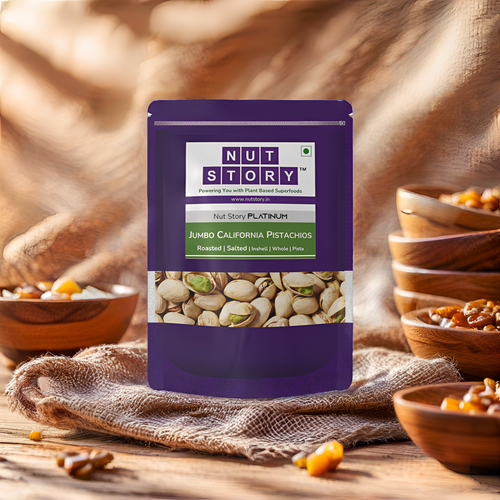
Explore Nut Story Pistachios & Related Products

- Choosing a selection results in a full page refresh.
- Opens in a new window.
- Opens external website.
- Opens external website in a new window.